Handheld vs Gimbal: Is a 1-Axis Mobile Gimbal Worth It?
Shaky phone video? What a mobile gimbal actually fixes, how a 1-axis gimbal like the Q08 compares with a 3-axis gimbal, a selfie stick and a tripod, and 7 tips for smoother clips.
In this guide
Video · 0:38
JIKRA Q08 Mini Gimbal: Handheld vs Gimbal Test and How to Switch It On
A 37-second video of the JIKRA Q08 mini gimbal, a 1-axis phone gimbal that also works as a selfie stick and a tripod. It opens with the same walk filmed twice, once with the phone held in hand and once on the Q08, side by side so you can compare the shake.
- 0:00 Handheld vs gimbal: the same walk side by side
- 0:05 The JIKRA Q08 gimbal and its stabilisation
- 0:12 Bluetooth remote for photos and videos
- 0:18 How to switch it on: press and hold the button
- 0:27 Who it is for
- 0:35 Price and where to order
Phone video shot by hand shakes. Every step, every breath and every small turn of the wrist shows on screen. A gimbal is the usual fix, and our Instagram reel puts the same clip side by side, handheld vs gimbal, so you can see the difference. This guide explains what a mobile gimbal fixes, what it doesn't, and how to choose between a 1-axis gimbal, a 3-axis gimbal, a selfie stick and a tripod.

Gimbal kya hai? What a mobile gimbal does
A gimbal is a handle with a small motor and a motion sensor that holds your phone. When your hand moves, the sensor notices and the motor turns the phone the other way, so the picture stays steadier. In simple words: your hand shakes, the phone shakes less.
Each motor works on one axis, one direction of movement:
- Roll: the picture leaning left or right. This is the wobble people notice most in handheld clips.
- Tilt: the phone nodding up and down.
- Pan: the phone swinging left and right as you turn.
None of the three cancels the up-and-down bounce of your body as you walk. That part is down to how you walk, see the tips below.
For the full explanation of how a gimbal works, the types and what each is used for, see what is a gimbal: meaning, types and uses.
1-axis vs 3-axis gimbal
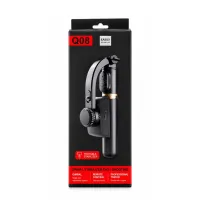
A 1-axis gimbal has one motor that keeps the phone level. It removes the tilting, wobbly look of handheld clips and makes small hand shake less visible. It is light, simple and affordable. The Q08 mini gimbal is a 1-axis gimbal, as printed on its box.
A 3-axis gimbal has three motors, for roll, tilt and pan, so it also smooths the phone nodding and swinging. It suits running shots, fast pans and paid work. 3-axis phone gimbals from known brands usually cost several times more and are bigger to carry.
For reels, travel clips, vlogs and family videos, the problem most people see is the tilt and the wobble, and a 1-axis gimbal deals with that.
Gimbal vs selfie stick vs tripod
| Selfie stick tripod | Mobile tripod stand | 1-axis gimbal | 3-axis gimbal | |
|---|---|---|---|---|
| Best for | Selfies and group photos at arm's length | Fixed-angle reels, cooking, makeup, video calls | Walking vlogs, travel clips, product videos while moving | Running, sports, fast pans, paid work |
| Keeps video level while you move | No | No, it stays in one place | Yes, with a motor | Yes, on three axes |
| Needs charging | No | No | Yes | Yes |
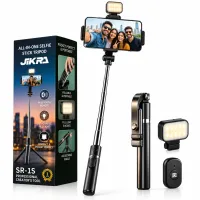
| At Jikra | SR-1S selfie stick tripod | 7 ft tripod stand | Q08 mini gimbal | Not stocked |
If you mostly take photos or film from one spot, a selfie stick tripod or a tripod stand is enough and costs less. If you film while walking or holding the phone, that is when a gimbal earns its place. More on stands in our guide to the best tripod for mobile and camera.
The Q08 mini gimbal in short
- 1-axis motorized stabilizer that keeps the phone level while you move.
- 3-in-1: handheld gimbal, extendable selfie stick and built-in tripod legs.
- Detachable Bluetooth remote for photos and group shots without touching the phone.
- Rotating phone clamp for vertical reels and horizontal videos.
- Battery: built-in 450 mAh, about 2 hours of use per charge, through the USB port on the handle.
- Fits phones 60 to 95 mm wide, so most Android phones and iPhones.
- Size: about 19 cm folded and about 250 g, and the stick extends to about 70–75 cm.
- No app needed: the motor and sensor are inside the handle, so you record with your normal camera app.
It costs ₹1,399 at the time of writing, with free shipping and cash on delivery. See the Q08 mini gimbal and its video.
How to use a mobile gimbal: 7 tips for smooth video
- Charge it fully before your first shoot.
- Clamp the phone in the centre before you switch on, so the motor is not fighting a phone that hangs to one side.
- Take off heavy cases and grips if the phone keeps leaning. Extra weight on one side makes the motor work harder.
- Hold it close to your body with your elbow bent, not at arm's length, for walking shots.
- Walk softly: knees slightly bent, heel to toe. This hides the bounce that no gimbal removes.
- Turn slowly. Quick turns still look jerky on a 1-axis gimbal.
- Keep your phone's own video stabilization on and tap to lock focus and exposure before you start. The phone and the gimbal work together.
New to gimbals? How to use a mobile gimbal walks through set-up, the remote, tripod mode and common fixes, and how to stabilize phone video covers OIS, EIS and phone settings.
Good light matters as much as steady hands: see how to use a ring light with your phone. For top-down cooking or unboxing clips, see how to set up a phone tripod for overhead recording.
Who should buy a gimbal, and who shouldn't
- Buy a 1-axis gimbal if you film walk-and-talk vlogs, travel, weddings and family events, shop or product videos, or reels where you move the phone by hand.
- Skip it if you only film from one spot, where a tripod is cheaper and steadier, or only take selfies, where a selfie stick tripod does the job.
- Go 3-axis if you film running, sports or bike rides, or want smooth cinematic pans for paid work.
Frequently asked questions
Is a gimbal the same as a stabilizer?
Yes. Gimbal, stabilizer, mobile stabilizer and anti-shake selfie stick are used for the same kind of product: a handle with a motor that steadies the phone.
Is the Q08 a 1-axis or 3-axis gimbal?
1-axis (single-axis), as printed on its box. It keeps the phone level. It does not have tilt and pan motors.
Does a gimbal work with iPhone and Android?
Yes. A phone gimbal holds any smartphone that fits its clamp, and the Q08's Bluetooth remote works as the camera shutter on Android phones and iPhones.
Can a gimbal remove all shake from walking?
No. No gimbal fully removes the up-and-down bounce of walking. Walk softly with bent knees and keep the gimbal close to your body.
Gimbal or tripod: which should I buy first?
If you film from one place, buy a tripod. If you film while moving, buy a gimbal. The Q08 has small tripod legs, so it covers table-top shots too.
More gimbal guides
Products in this guide
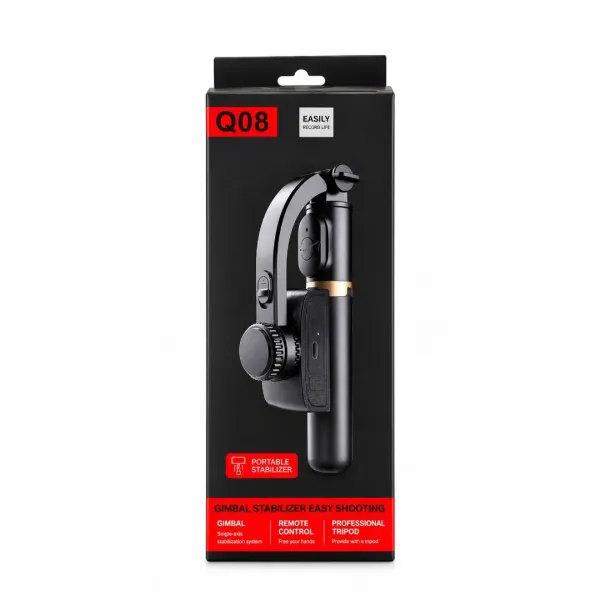
Q08 Mini Gimbal Anti-Shake Stabilizer – 1-Axis Handheld Smartphone Gimbal with Extendable Selfie Stick, Built-in Tripod & Portable Phone Holder for Smooth Videos and Vlogging
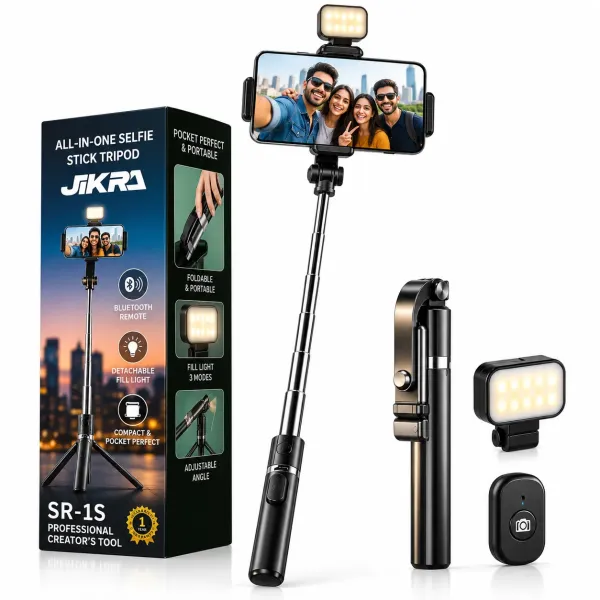
JIKRA SR-1S 3-in-1 Selfie Stick Tripod with Bluetooth Remote - Detachable Fill Light
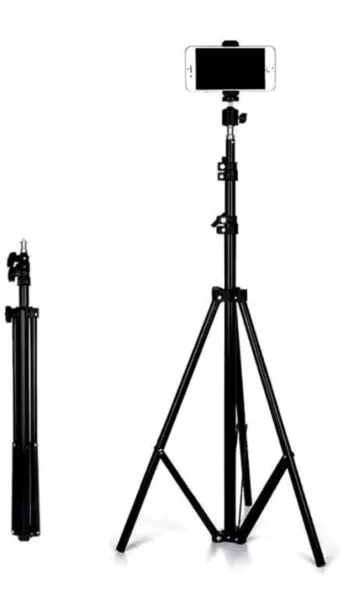
JIKRA Tripod Stand for Mobile & Video Camera – 213 cm (7 ft) Tall, Adjustable